To summarise this question in a creative way, I decided to create a fake interview between me and my mum. My mum playing the role of the presenter and me playing the role of a book author who has just recently published a book about slasher genre conventions.
...
Here is my general film opening conventions vodcast from my earlier on in my blog:
...
...
Here is my slasher genre conventions vodcast from my earlier on in my blog:
...
...
Also, for this question, I decided to use the YouTube annotation tool to annotate my final cut to explain why I did/included certain things and what films I was influenced by for many parts of my film opening, you can turn these annotations off or on, on the settings button on the right bottom hand corner:
...
...
"A slasher film is a sub-genre of the horror film genre typically involving a psychopathic killer stalking and killing a sequence of victims in a graphically violent manner, often with a cutting tool such as a knife or chainsaw etc."
The many general genre films I have looked at are Bridget Jones's Diary, For Those In Peril, Submarine, We Are Your Friends, Wild Child, The Girl On The Train, The Girl With The Dragon Tattoo, Pulp Fiction, The Boss, Oblivion and This Is England.
The many slasher genre films I have looked at are Halloween, Scream franchise, Bride Of Chucky, Friday the 13th franchise, Jennifer's Body, Scary Movie, Cherry Falls, Psycho, Nightmare On Elm Street, and Texas Chainsaw Massacre.
IDENTS
I found after looking at many film examples e.g. Bridget Jones's Diary and Friday the 13th Remake, that the average amount of film idents to be shown at the start of a film is 3-4 with/or without an audiobridge (audiobridges connote the genre of the film and create a certain atmosphere for the audience). Therefore, I made 3 film idents for my film opening which you can see here. After looking at the examples, Friday the 13th Remake, Wild Child, Oblivion and The Girl With The Dragon Tattoo, I decided to include an audiobridge over two of my film idents. Also, the average duration of the film idents I made is between 5-10 seconds because after looking into many film examples of multiple genres, I discovered that the average duration of idents is 5-10 seconds. Although, after looking at many slasher genre examples, I discovered that not many film idents are shown at the start, e.g. for 'Scream' and 'Bride Of Chucky' there is only one film ident shown at the start.
OPENING SHOT
 After looking at multiple genre examples e.g. The Girl With The Dragon Tattoo, Halloween, Bride Of Chucky,
Oblivion and The Boss, I discovered that the stereotypical opening shot used is an extreme long shot. This provides exposition for the audience and denotes the setting/time. Although, I did look at some other examples, e.g. For Those In Peril, Scream and The Girl On The Train and discovered that the opening shot used is not always an ELS but instead, a close up shot of an object or person of significance (a signifier). These two options for the opening shot influenced me for my film opening. I therefore decided to use a medium close up of the female rape victim's legs running. I chose this type of shot because I wanted to provide some narrative enigma (withholding information) in my film opening. Narrative enigma is created because the audience don't know who the character in the shot is (because you can only see the character's legs, not her face). You finally see the character's face in the third shot in.
TITLES
After looking at the slasher film examples Bride Of Chucky, Friday the 13th Remake and Halloween, I have discovered that colour, font and font size connote genre. In the film openings of these film examples there are a lot of titles used and the font colours are either white, red or orange. This helped me decide how many titles I wanted to use in my film opening and what kind of font and colour I shall use for these titles. I decided on the font 'face your fears' (from dafont.com) in the colour red. This font is sans serif and can be denoted as blood, written with a paintbrush and it has strong connotations of horror.
 I got the 'face your fears' font for my film opening from the website, dafont.com. I also got many other fonts from this website for my film idents too. For the 'Lilac City Productions' ident I used the font 'Eddie DGL' as you can see below.
 This is the font I used for my second ident (Lilac City Productions). I denoted this font as being sci-fi, but also somewhat Chinese like. I wanted to have a Chinese styled font because Chinese letters/writing is associated with sci-fi cities with really modern skyscrapers. The fact that Chinese writing is associated with modern cities influenced the name I picked for the ident also, (Lilac City Productions).
I also did research into the typical title order that you will see by looking at the examples 'The Girl With The Dragon Tattoo', 'Bride Of Chucky', and 'Halloween' and discovered that the typical order is usually:

This helped me decide the order for my titles:

...
1. Ethereal Entertainment Presents
My first ident
...

2. A Lilac City Production
My second ident
...
 3. In Association with Neonix Productions
My third ident
...
 4. An Evie Gibbons film

...
5. Sophie Turner
Sophie Turner is an actress from the TV series 'Game of Thrones'. I chose to choose this actress because she attracts an international audience because of her appearance in Game of Thrones.
...
 7. Robert Sheehan
Robert Sheehan is an Irish actor from the TV series 'Misfits' and appears in 'Demons Never Die' and 'Mortal Instruments - City Of Bones'. I chose this actor because he attracts a young adult audience and his appearance in the low budget horror slasher film 'Demons Never Die' attracts an audience who watches slasher horrors/likes slasher horror films.
...
 8. Casting by Lisa Fields
This woman casted the film Friday The 13th Remake.
...
 9. Music by Steve Jablonsky
This music composer made the music for the slasher film Friday the 13th Remake and I chose this music composer because I really liked the soundtrack that was made for that film.
...
 10. Edited by Daniel Duncan
This person edited the film I Spit On Your Grave.
...
 11. Written by Steven Zaillian
He wrote the film The Girl With The Dragon Tattoo
...
 12. Produced by Cathy Konrad
This woman produced the film Scream.
...
 13. Directed by Evie Gibbons
...
FINAL SHOT OF FILM OPENING
 After looking at many final shots of film openings for films e.g. Scream, I discovered that the final shot is usually of something that links the film opening to the main body of the film e.g. a new character's face that we haven't seen before or of the main protagonist's face in a new scene. I also discovered that it is sometimes hard to distinguish when it is the end of a film opening or when it is the start of the main body of the film, this is the case for the example 'The Girl On The Train' and 'Oblivion'. This influenced me to make my final shot for my film opening, a close up of the main protagonist's face (the 'final girl' character) as you can see here. If I were to film the entire film, I would have had a close up shot of the main protagonist in a new scene, after this shot. By doing this, this allows there to be a transition/bridge from the film opening to the main body of the film.
SHOT TYPES
In my film opening I used a variety of different shot types such as long shots, extreme long shots, medium long shots, close ups, two shots, master shots. In terms of shot angles, I also used many different types such as worm's eye angle view, low angles, high angles and dutch angles. I wanted to use many dutch angles because this is a very stereotypical convention of horror slashers. I used high angles and low angles to connote different statuses of power, for example for portraying the killer I used low angles to connote that the killer has a lot of power; For portraying the female rape victim in the rape chase scene, I used many high angles to connote that she is weak and vulnerable.
IDENTIFYING ANY PROTAGONISTS
After looking at many film examples, e.g. The Girl On The Train, Scream, Wild Child, The Boss and Oblivion, I have discovered that the main protagonist is typically the first character to be shown. They may not appear in the opening shot, but they would typically appear a few shots later in the film opening. In the case of slasher films however, the first character/s shown is usually the 'scream queen/king' (the person who will be killed by the killer). A 'scream queen' in a slasher film opening will usually be killed in the film opening itself, not even make it until half way through the film. This influenced me a lot because my film opening is of the slasher genre. Because of this, I decided to show two 'scream kings' in my film opening (the two rapists who raped the killer) first, including the female rape victim who turns into the killer. I thought it was important to provide some background context for the audience around the killer and her motives for killing people.
The audience only see the main protagonist at the very end of the film opening just before the main body of the film starts. The main protagonist is the 'final girl' and she is female (which is stereotypical for slasher films) as you have seen above in this post.
NARRATIVE
I looked into multiple genre examples and discovered that in the film openings of films, the following theories can be applied: Roland Barthes' 5 Codes, Levi-Strauss' Binary Opposition, Propp's 7-Character Archetypes and Todorov's 5-Part Narrative.
Barthes stated that there are 5 codes which can appear in a media text, these being the enigma code, the action code, the semantic code, the symbolic code and the cultural code. For example, the action code and the enigma code can be applied in the film 'The Girl With The Dragon Tattoo' because in the film opening the audience have no idea what is going on, they see two characters talking on the phone to each other, but they are not being very clear to the audience of what they are talking about; therefore, narrative enigma is created. At the end of the film, the action code starts to become evident through the chase scene that you see. I was influenced by this, therefore I included the enigma code and action code in my film opening. The enigma code is applied in the first scene of my film opening, the rape chase scene. This is because it is not clear to the audience who the female rape victim is and also why she is being chased.
Levi-Strauss developed the concept of binary opposites. These are two very distinct opposites or clashing pairs you could say, for example (male, female; rich, poor). They are used to spark or create conflict for a film. This can be applied in the example Harry Potter. Voldemort and Harry Potter are a clashing pair - villain vs hero. I was influenced to apply this in my film opening between the killer and the female rape victim. These two characters are the same person (Jennifer), just the killer version of Jennifer is a lot different to the female rape victim version of Jennifer. The killer version wears all black, is villainous, dominant and kills people. The female rape victim version is feminine, innocent, vulnerable and submissive. So, the binary here is dominant vs submissive and also evil/vengeful vs kind/innocent.
Uses and Gratifications Theory
1. Diversion/Escapism
2. Personal Relationship
3. Personal Identity
4. Surveillance
Diversion/Escapism:
An audience may be able to escape into my film because of it's dramatic nature. Also, it is a fiction film which is non-realistic so people can watch this for pleasure as a fictional media product.
Personal Identity
I think the target audience can identify with some of the characters in this film such as the final girl and the scream queens/scream kings. I think teenage males and females might be able to identify with the final girl because she is relatable as a teenager by wearing make up, doing teenage activities, being a school student etc... I also think a some males may identify with the two male rapists mainly just because they are somewhat young. Also, there is reference to alcoholism by one of the teenagers, Simon, who sneaks some alcohol in a flask to a greenscreen studio, I think this alcoholism/drinking alcohol is relatable to teenagers also.
SOUND
Throughout my film opening, I made and used a combination of diegetic and non-diegetic sounds. I used a variety of dark drones that connote wind, heartbeat sounds.
Rape Chase Scene:
Green Screen Abduction Scene:
Diegetic Sounds:
I made my own version of the theme music from the film Halloween. I only used this music in the part where the killer is walking up behind Simon about to put a bag over his head.
Lair Scene:
Diegetic Sounds:
Rape Chase Scene:
Setting
The location of this scene is very stereotypical of horror films. Most horror films are set in a forest at some point e.g. Friday the 13th, I Spit On Your Grave, Cherry Falls, Eden Lake. I decided to use this location because of these influences.
Green Screen Abduction Scene:
Setting
This scene is set at a greenscreen studio. I took influence from the film Halloween by having stalkerish shots as Simon walks from one studio to the other. In the film opening of Halloween, Michael Myers watches and stalks his sister and her boyfriend kissing and playing around. In my film opening, the killer stalks and watches Simon heading from one greenscreen studio to the other.
Lair Scene:
Setting
This scene is set in the killer's lair. This is very stereotypical of horrors for the killer to have a lair where they take their victims and torture/kill them. I was influenced by the TV show Pretty Little Liars because the anonymous 'A', in this show, has a lair with images taped up on all the walls as if the person who's lair it is is a major stalker of certain people. In my film opening I decided to incorporate some of the things that the anonymous 'A' villain has in Pretty Little Liars. I decided to create a lair for the killer in my film opening which has many objects that represent/connote the horror genre. I included:
 |
| My Film Ident 1: Ethereal Entertainment |
 |
| My Film Ident 2: Lilac City Productions |
 |
| My Film Ident 3: Neonix Productions |
OPENING SHOT

Oblivion and The Boss, I discovered that the stereotypical opening shot used is an extreme long shot. This provides exposition for the audience and denotes the setting/time. Although, I did look at some other examples, e.g. For Those In Peril, Scream and The Girl On The Train and discovered that the opening shot used is not always an ELS but instead, a close up shot of an object or person of significance (a signifier). These two options for the opening shot influenced me for my film opening. I therefore decided to use a medium close up of the female rape victim's legs running. I chose this type of shot because I wanted to provide some narrative enigma (withholding information) in my film opening. Narrative enigma is created because the audience don't know who the character in the shot is (because you can only see the character's legs, not her face). You finally see the character's face in the third shot in.
TITLES
After looking at the slasher film examples Bride Of Chucky, Friday the 13th Remake and Halloween, I have discovered that colour, font and font size connote genre. In the film openings of these film examples there are a lot of titles used and the font colours are either white, red or orange. This helped me decide how many titles I wanted to use in my film opening and what kind of font and colour I shall use for these titles. I decided on the font 'face your fears' (from dafont.com) in the colour red. This font is sans serif and can be denoted as blood, written with a paintbrush and it has strong connotations of horror.
 I got the 'face your fears' font for my film opening from the website, dafont.com. I also got many other fonts from this website for my film idents too. For the 'Lilac City Productions' ident I used the font 'Eddie DGL' as you can see below.
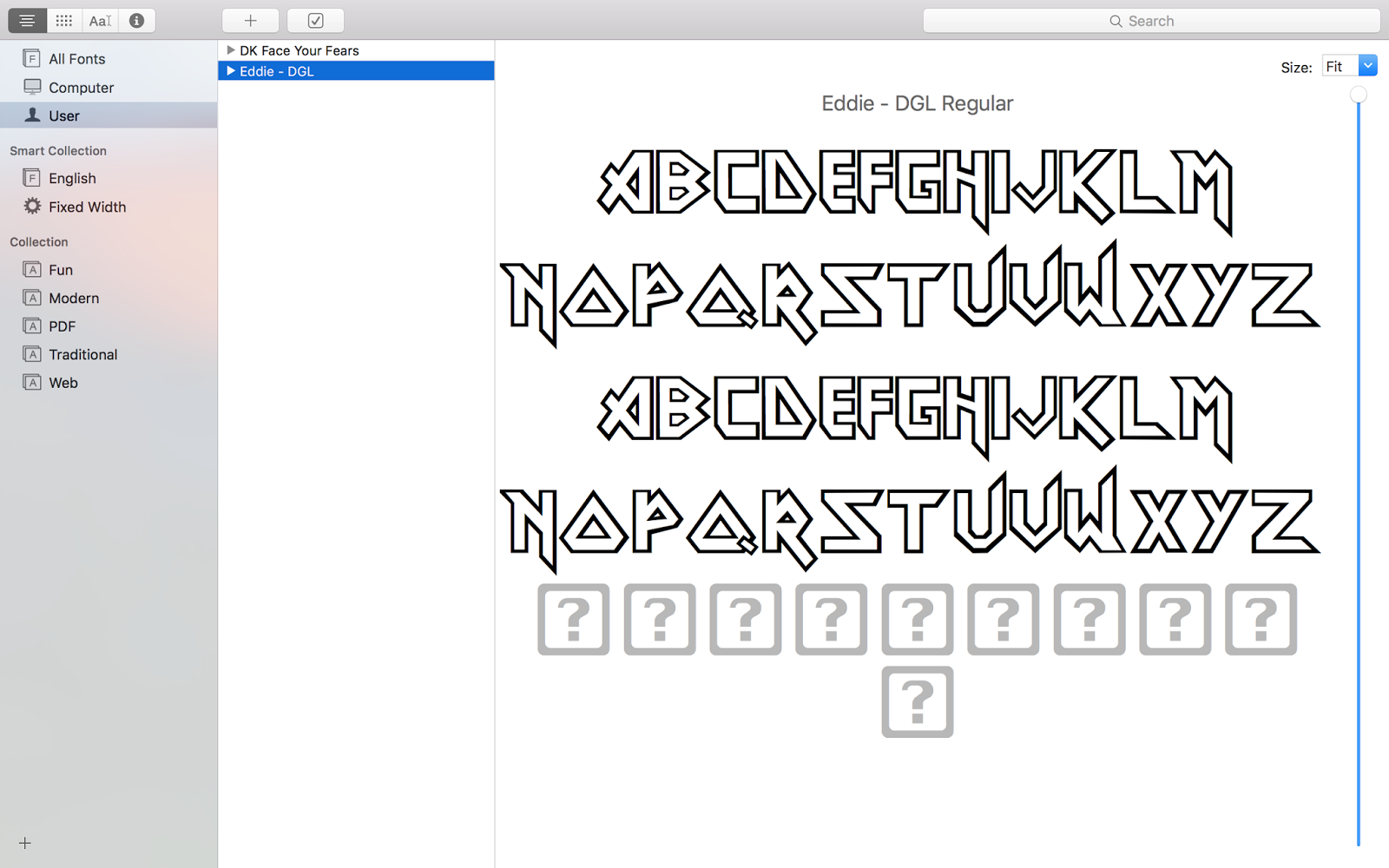
I also did research into the typical title order that you will see by looking at the examples 'The Girl With The Dragon Tattoo', 'Bride Of Chucky', and 'Halloween' and discovered that the typical order is usually:

This helped me decide the order for my titles:

...
1. Ethereal Entertainment Presents
My first ident
...

2. A Lilac City Production
My second ident
...

My third ident
...


...
5. Sophie Turner
Sophie Turner is an actress from the TV series 'Game of Thrones'. I chose to choose this actress because she attracts an international audience because of her appearance in Game of Thrones.
...
 7. Robert Sheehan
Robert Sheehan is an Irish actor from the TV series 'Misfits' and appears in 'Demons Never Die' and 'Mortal Instruments - City Of Bones'. I chose this actor because he attracts a young adult audience and his appearance in the low budget horror slasher film 'Demons Never Die' attracts an audience who watches slasher horrors/likes slasher horror films.
...
 8. Casting by Lisa Fields
This woman casted the film Friday The 13th Remake.
...
 9. Music by Steve Jablonsky
This music composer made the music for the slasher film Friday the 13th Remake and I chose this music composer because I really liked the soundtrack that was made for that film.
...
 10. Edited by Daniel Duncan
This person edited the film I Spit On Your Grave.
...
 11. Written by Steven Zaillian
He wrote the film The Girl With The Dragon Tattoo
...
 12. Produced by Cathy Konrad
This woman produced the film Scream.
...

...
FINAL SHOT OF FILM OPENING

SHOT TYPES
 |
| Use of worm's eye view angle |
In my film opening I used a variety of different shot types such as long shots, extreme long shots, medium long shots, close ups, two shots, master shots. In terms of shot angles, I also used many different types such as worm's eye angle view, low angles, high angles and dutch angles. I wanted to use many dutch angles because this is a very stereotypical convention of horror slashers. I used high angles and low angles to connote different statuses of power, for example for portraying the killer I used low angles to connote that the killer has a lot of power; For portraying the female rape victim in the rape chase scene, I used many high angles to connote that she is weak and vulnerable.
 |
| Use of dutch angle here |
 |
| Use of dutch angle and high angle |
IDENTIFYING ANY PROTAGONISTS
 |
| Rapist 1/Scream King 1 |
 |
| Rapist 2/Scream King 2 |
The audience only see the main protagonist at the very end of the film opening just before the main body of the film starts. The main protagonist is the 'final girl' and she is female (which is stereotypical for slasher films) as you have seen above in this post.
 |
| Female rape victim (Jennifer) |
 |
| Female killer (Jennifer) |
NARRATIVE
I looked into multiple genre examples and discovered that in the film openings of films, the following theories can be applied: Roland Barthes' 5 Codes, Levi-Strauss' Binary Opposition, Propp's 7-Character Archetypes and Todorov's 5-Part Narrative.
 |
| Opening shot of my film opening (provides narrative enigma) |
Levi-Strauss developed the concept of binary opposites. These are two very distinct opposites or clashing pairs you could say, for example (male, female; rich, poor). They are used to spark or create conflict for a film. This can be applied in the example Harry Potter. Voldemort and Harry Potter are a clashing pair - villain vs hero. I was influenced to apply this in my film opening between the killer and the female rape victim. These two characters are the same person (Jennifer), just the killer version of Jennifer is a lot different to the female rape victim version of Jennifer. The killer version wears all black, is villainous, dominant and kills people. The female rape victim version is feminine, innocent, vulnerable and submissive. So, the binary here is dominant vs submissive and also evil/vengeful vs kind/innocent.
Uses and Gratifications Theory
1. Diversion/Escapism
2. Personal Relationship
3. Personal Identity
4. Surveillance
Diversion/Escapism:
An audience may be able to escape into my film because of it's dramatic nature. Also, it is a fiction film which is non-realistic so people can watch this for pleasure as a fictional media product.
Personal Identity
I think the target audience can identify with some of the characters in this film such as the final girl and the scream queens/scream kings. I think teenage males and females might be able to identify with the final girl because she is relatable as a teenager by wearing make up, doing teenage activities, being a school student etc... I also think a some males may identify with the two male rapists mainly just because they are somewhat young. Also, there is reference to alcoholism by one of the teenagers, Simon, who sneaks some alcohol in a flask to a greenscreen studio, I think this alcoholism/drinking alcohol is relatable to teenagers also.
SOUND
Throughout my film opening, I made and used a combination of diegetic and non-diegetic sounds. I used a variety of dark drones that connote wind, heartbeat sounds.
Rape Chase Scene:
- Dark drones which sound like wind
- Heartbeat sound
Green Screen Abduction Scene:
Diegetic Sounds:
- Strings
- Synths
I made my own version of the theme music from the film Halloween. I only used this music in the part where the killer is walking up behind Simon about to put a bag over his head.
Lair Scene:
Diegetic Sounds:
- I used the same drone that I used in the first scene in this scene.
- Heartbeat sound
- Drill sound
- I made my own version of the music from the shower scene in the film Pyscho for the final part of the lair scene when the killer starts walking towards Alex, this builds up the tension and scare for the audience because she is about to kill Alex.
Rape Chase Scene:
Setting
The location of this scene is very stereotypical of horror films. Most horror films are set in a forest at some point e.g. Friday the 13th, I Spit On Your Grave, Cherry Falls, Eden Lake. I decided to use this location because of these influences.
Green Screen Abduction Scene:
Setting
This scene is set at a greenscreen studio. I took influence from the film Halloween by having stalkerish shots as Simon walks from one studio to the other. In the film opening of Halloween, Michael Myers watches and stalks his sister and her boyfriend kissing and playing around. In my film opening, the killer stalks and watches Simon heading from one greenscreen studio to the other.
Lair Scene:
Setting
This scene is set in the killer's lair. This is very stereotypical of horrors for the killer to have a lair where they take their victims and torture/kill them. I was influenced by the TV show Pretty Little Liars because the anonymous 'A', in this show, has a lair with images taped up on all the walls as if the person who's lair it is is a major stalker of certain people. In my film opening I decided to incorporate some of the things that the anonymous 'A' villain has in Pretty Little Liars. I decided to create a lair for the killer in my film opening which has many objects that represent/connote the horror genre. I included:
- Knives
- Hammers
- Fake blood
- Drills
- Bucket of water
- Fresh roar meat
- Tape
- Piece of cloth to tie the victim's hands together.
- Wire to wrap around the victim's legs to stop him from escaping.
- Plastic sheeting
- Many candles lit of all sizes
- Saws
After looking at many slasher film examples, I discovered that there is frequent use of low key lighting so therefore I have to tried to apply this in some scenes of my film opening e.g. the lair scene.
Lighting:
Lighting:
Low key lighting is used in horror films to give the effect of something bad is about to happen for example shadows and light flickering makes the audience feel scared and nervous. As well as this, lighting can be used to give the mood in horror films, usually when some one is scared its quite dark and is usually raining outside. It can also be used to create a personality of a character by casting shadows across there face to create a sinister minded character or a split personality of a character. So, the lighting is usually low key and dark.
Props:
The main props used are the killer's weapons e.g. knifes, hammers, axes, chainsaws, saws, rope, cable ties, chokers, plastic bags etc... Also, there can be antiques and paintings which are a big prop used to create a dark and sinister scene.
Colour Scheme:
Colours used within horror films are usually reds or blacks because they connote danger, and death. The background colours are usually black with hints of dark red at times. The colours can also be pale (sometimes) e.g. twilight has a lot of elements of pale colouring of the scenes; the reason for that film to use pale colouring is because of the slight genre of horror that is in that film (vampires are usually pale and they drink blood which therefore connotes a horror genre). The colour red connotes blood majorly; the genre of horror expects to see a lot of blood so that is why the colour red is used for a lot of things e.g. font or colour/special effects.


